Man versus machine: 150 startups, scored by analysts and by Kuanta.
An independent RSM study compared a human jury and Kuanta on 150 startups, then tracked funding and survival. What it found, and what it means for how you evaluate startups.
Kuanta Intelligence Team4 min read
TL;DR
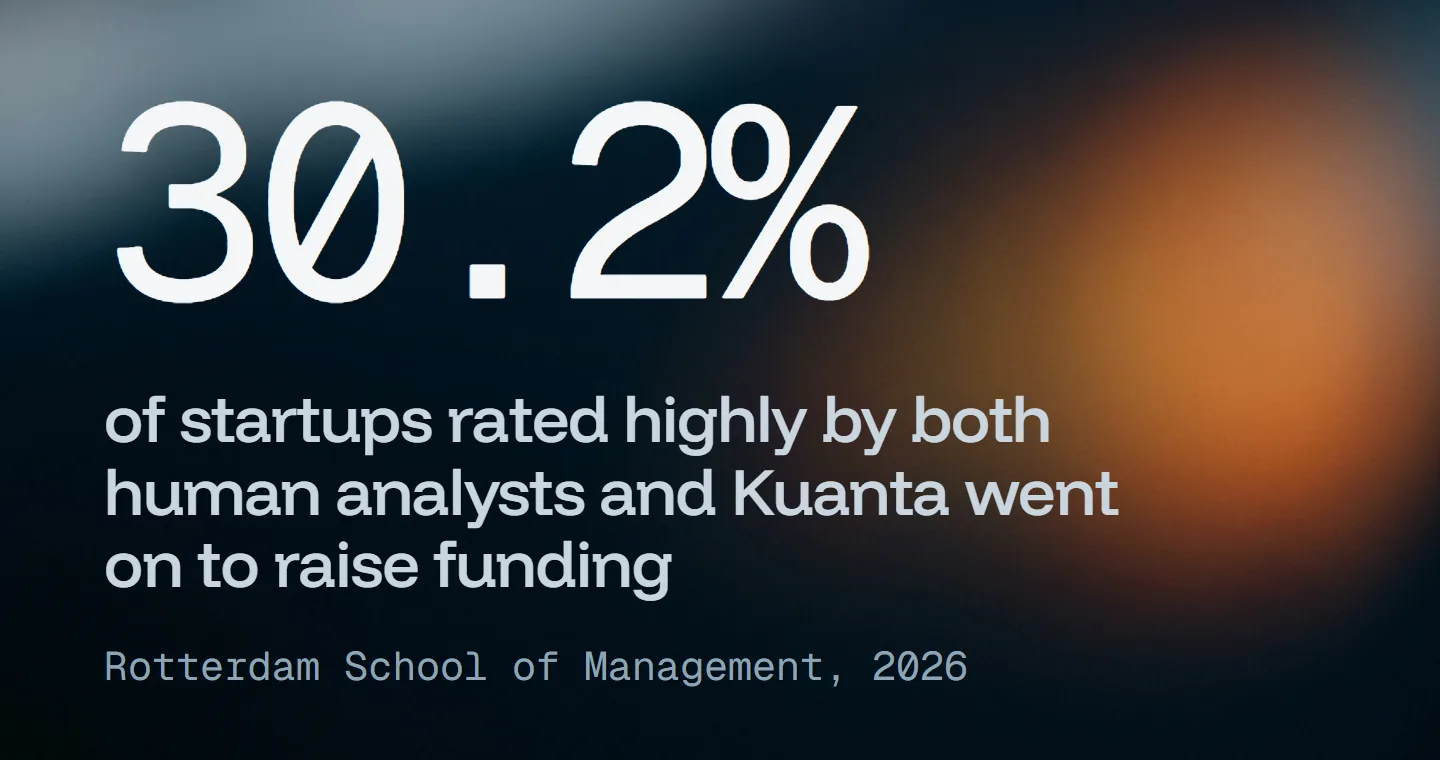
When human analysts and Kuanta both rated a startup highly, 30.2% went on to raise funding. When both rated it low, none did. That is the main finding of an independent study at Rotterdam School of Management, which took 150 startups from three years of the Philips Innovation Awards, had them scored by a jury and by Kuanta, and then tracked what happened to them.
Kuanta matched the jury on overall accuracy and found more of the startups that later raised. Where the two disagreed, the startups Kuanta favored did better. The study's advice is to run both side by side and look hardest where they disagree.
A student with a simple question
Earlier this year Laurens Meijer, a master's student at Rotterdam School of Management, picked a research question that we could not have asked ourselves without being accused of marking our own homework. He wanted to know how Kuanta compares with human analysts when both look at the same early-stage startups, and whether either of them can tell which companies will go on to do well.
He has no financial or employment relationship with Kuanta and was not paid for the work. We gave him access and then waited, which is a less comfortable experience than it sounds.
How he set it up
The sample came from the Philips Innovation Awards, the largest entrepreneurship competition in the Netherlands. He took 150 startups from the 2022, 2023 and 2024 cohorts, all of which had already been scored by an independent jury of human analysts on innovation, team, market and financials.
Kuanta then evaluated exactly the same documents without seeing the jury's scores. After that came the slow part: tracing through public sources what had actually happened to each company, whether it raised funding and whether it was still alive, and checking the results by hand.
Is AI better than human analysts at evaluating startups?
In this study, Kuanta matched the jury on overall accuracy. Its scores lined up moderately with the jury's, most closely on the quality of the team and least on market size and financial projections, which are the parts of a plan that are hardest to verify.
The difference showed up in which companies each one picked. Across every model he tested, Kuanta identified more of the startups that later raised money. In venture that matters a great deal, because missing a future winner costs far more than reading one extra plan.
The most striking result, though, was about agreement.
139 of the 150 startups fall into these four groups.
When the jury and Kuanta both liked a company, it did far better than when only one of them did. When both were unconvinced, not a single company raised funding. The two disagreed on roughly four in ten startups, and in those cases the companies Kuanta favored did better on both measures.
A second study, from the other side of the table
A second study at Rotterdam School of Management looked at what happens to the people making the decision. Seventeen VC analysts read a startup’s pitch and made a recommendation, then read the Kuanta analysis of the same company, and their recommendations moved. The researchers traced the shift to weaknesses and inconsistencies the pitch had kept out of view. The largest and most consistent effect sat with the analysts themselves: after reading the analysis, they trusted their own judgment more.
What we take from it
The study's recommendation is to run both reads side by side: move quickly on the startups that the analysts and Kuanta both rate highly, drop the ones they both reject, and spend your time on the disagreements, because that is where the overlooked companies tend to be.
That matches what we see in practice. Kuanta brings outside data on the product and the market, while an experienced analyst brings judgment about people and about the story being told. They read different signals, which is why it makes sense to read both.
The research summary is on our homepage: Read the research summary (PDF)
Sources
L. Meijer (2026). Man versus machine: comparing human analysts and agentic AI in early-stage venture evaluation. Master's thesis, Rotterdam School of Management, Erasmus University.